

AI visibility across the marketing funnel, from TOFU to BOFU.
From the first question at the top of the funnel to the final pick at the bottom.
Your buyers now ask Google AI Mode, ChatGPT, Claude, Perplexity and Gemini for recommendations. TofuBofu shows whether you are getting mentioned, then writes and publishes the content that gets you recommended.

 AI Visibility Analyst
Free forever · one full scan a month · about 3 minutes · no card, no password
Measured by the TofuBofu AI Visibility Index
- Tofu Index: are you getting mentioned?
- Each query is put to each engine. The share of those answers that name you.
- Bofu Index: are you getting recommended?
- You against one named rival, on each engine. The share where the engine picks you.
- Rank: where do you stand?
- Your place among every brand the engines name for your queries.
Example numbers. A free scan measures your Tofu Index on every engine; paid plans add the Bofu Index. How each one is counted →
Free forever · one full scan a month · about 3 minutes · no card, no password
Every engine we query searches the live web before it answers. A low number means buyers cannot find you, not that we never looked.
 Google AI Mode
 ChatGPT
 Perplexity
 Gemini
AI engines rewired the B2B buying funnel.
Buyers still move from TOFU to MOFU to BOFU. Now an AI engine sits at every stage, and it decides who makes the list. How the funnel works →
- TOFU · Discovery
Then: a Google search and ten blue links.
Now: one AI answer names a shortlist of firms. Not named, not considered.
- MOFU · Consideration
Then: review sites, case studies, a referral.
Now: the buyer asks the engine to compare the shortlist. It answers from what it can read about you.
- BOFU · Decision
Then: a sales call settled it.
Now: “X or Y?” The engine picks one, before you ever get the call.
of B2B software buyers start research with an AI chatbot more often than Google, up from 29% in 2025.
chose a different vendor than planned, based on what AI told them.
bought from a vendor they were not familiar with.
Source: G2, The Answer Economy: 2026 AI Search Insight Report, 1,076 B2B software buyers, March 2026.
Being mentioned is not the same as being recommended.
Most AEO and GEO tools hand you one visibility score. Your AI Visibility Index has two parts, one for each end of the funnel. Being on the shortlist and being the pick are different problems with different fixes.
Tofu Index · top of funnel
Are you getting mentioned?
A buyer asks an engine for firms like yours. Did it name you? We count it per engine, because each engine is a separate shortlist.
Bofu Index · bottom of funnel
Are you getting recommended?
A buyer puts you head to head with a named rival. Did the engine pick you? Being mentioned and being recommended are different wins, and most brands only have the first.
The denominator, shown: 25 queries across 5 engines is 125 queries, because the same query put to 5 engines is 5 answers. The Tofu Index is how many of those 125 named you. Every engine searches the live web first, so a miss means buyers cannot find you, not that we never looked.
How both indices are counted →Where you land on both tells you what to fix first.

Untested win
High Bofu, low Tofu. You win comparisons few buyers are asking for, usually because nothing contests them. Widen your reach before a rival shows up.
The default answer
AI names you and picks you. Defend it: weekly re-scans, fresh sources, new queries as the category moves.
Invisible
AI neither names you nor picks you. Start on your own site: make it readable to engines, then publish pages that answer buying queries.
Shortlisted, not picked
AI knows you and recommends the rival. On-site buys you the description; third-party proof buys you the decision.
Everything your buyers' AI says about you, in one place.
Measure where you stand, see why, then fix it. These are the real screens, filled with an illustrative account.
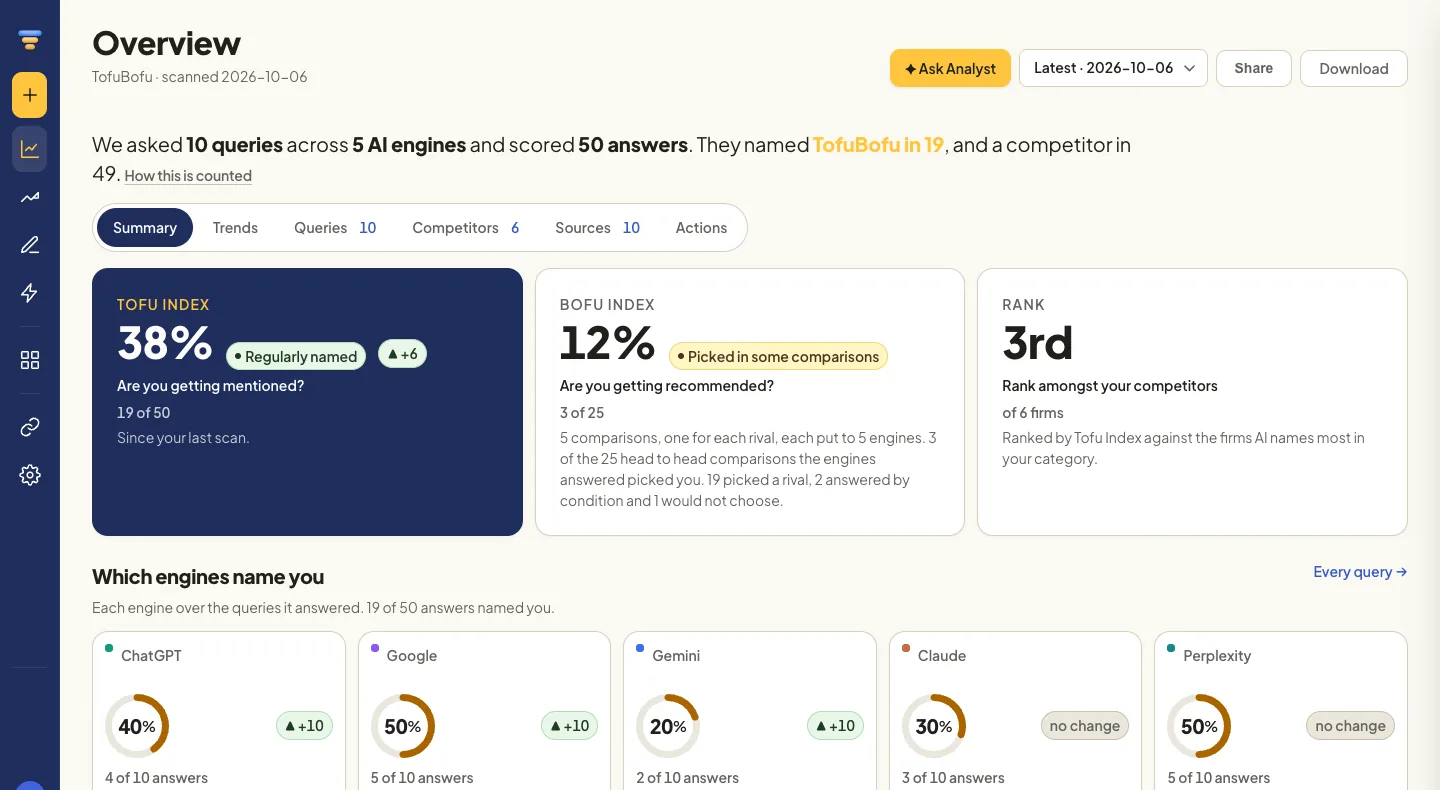
Where you stand, on one screen.
Your Tofu Index, your Bofu Index and your rank against every brand AI names, with each engine scored beside them. Every figure is a count you can open, never a blended score.
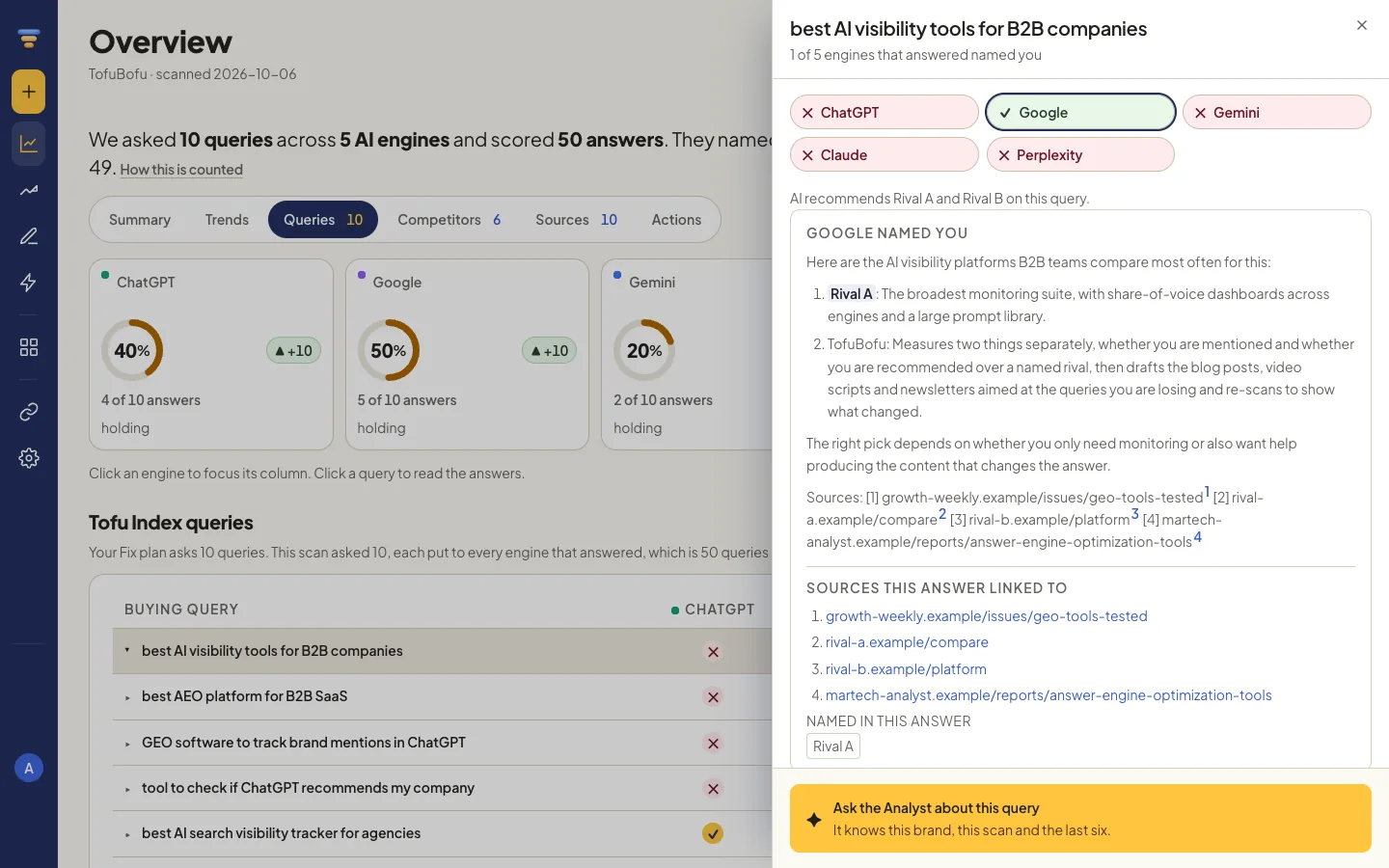
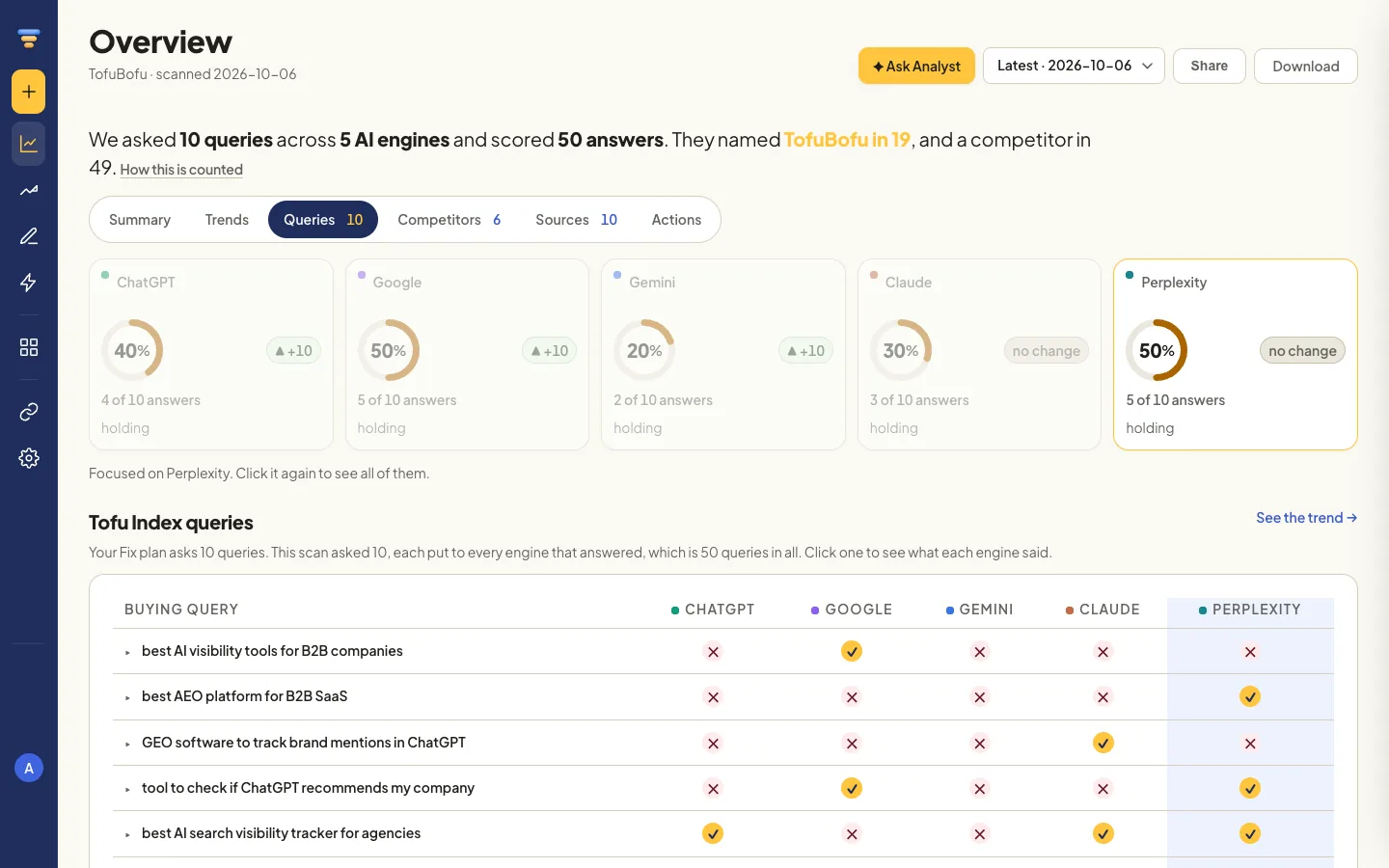
Read what each engine actually said.
Every buying query on every engine, as a grid of ticks. Open one to read each engine's full answer, the pages it linked and the rivals it named instead of you.
Each engine is its own shortlist.
Every engine is scored on its own answers, with the change since your last scan. Pick one to see exactly which queries it named you on.
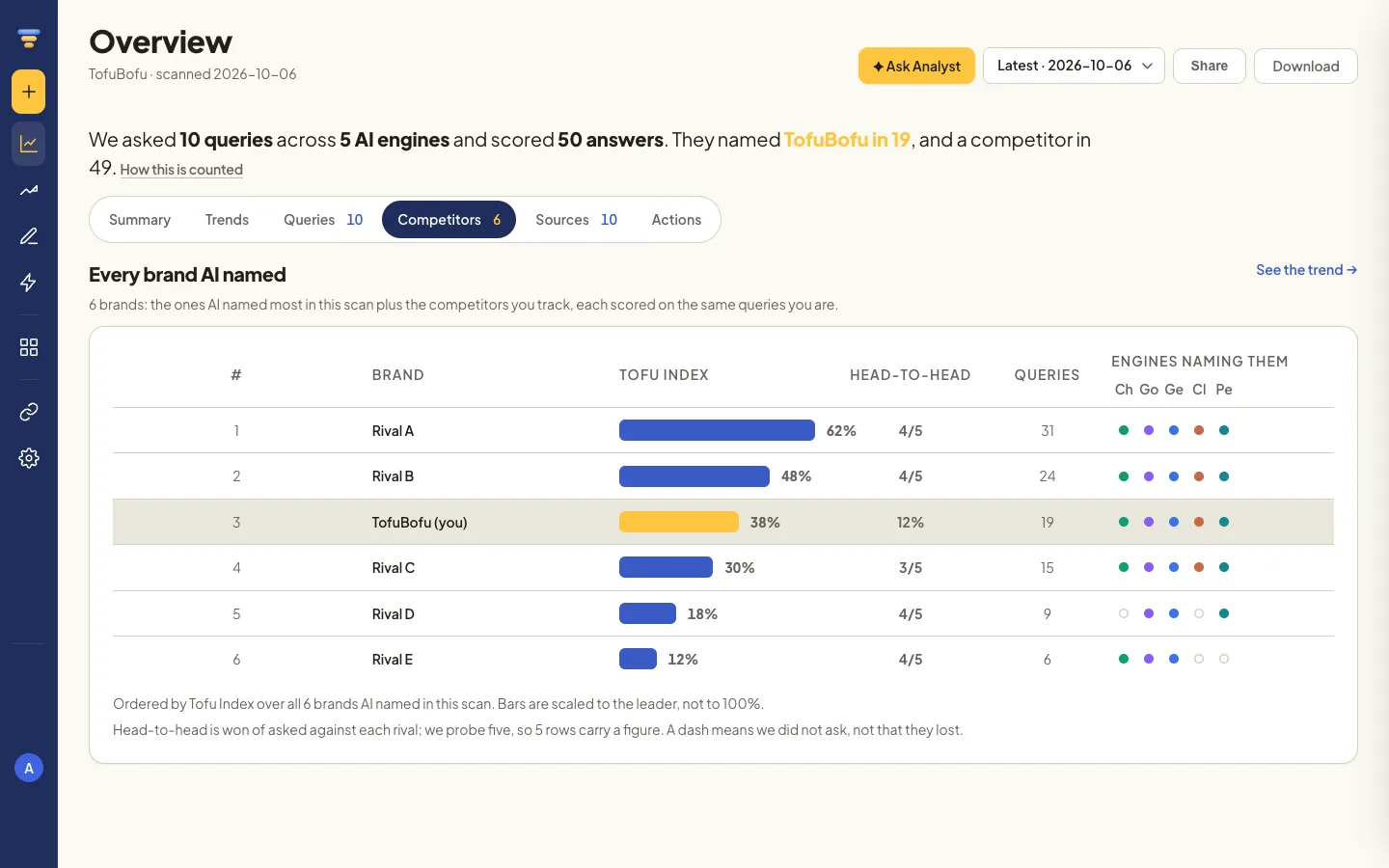
See who AI names instead of you.
Every brand AI named in your category, ranked by Tofu Index on the same queries as you, with your head-to-head record against each rival you track.
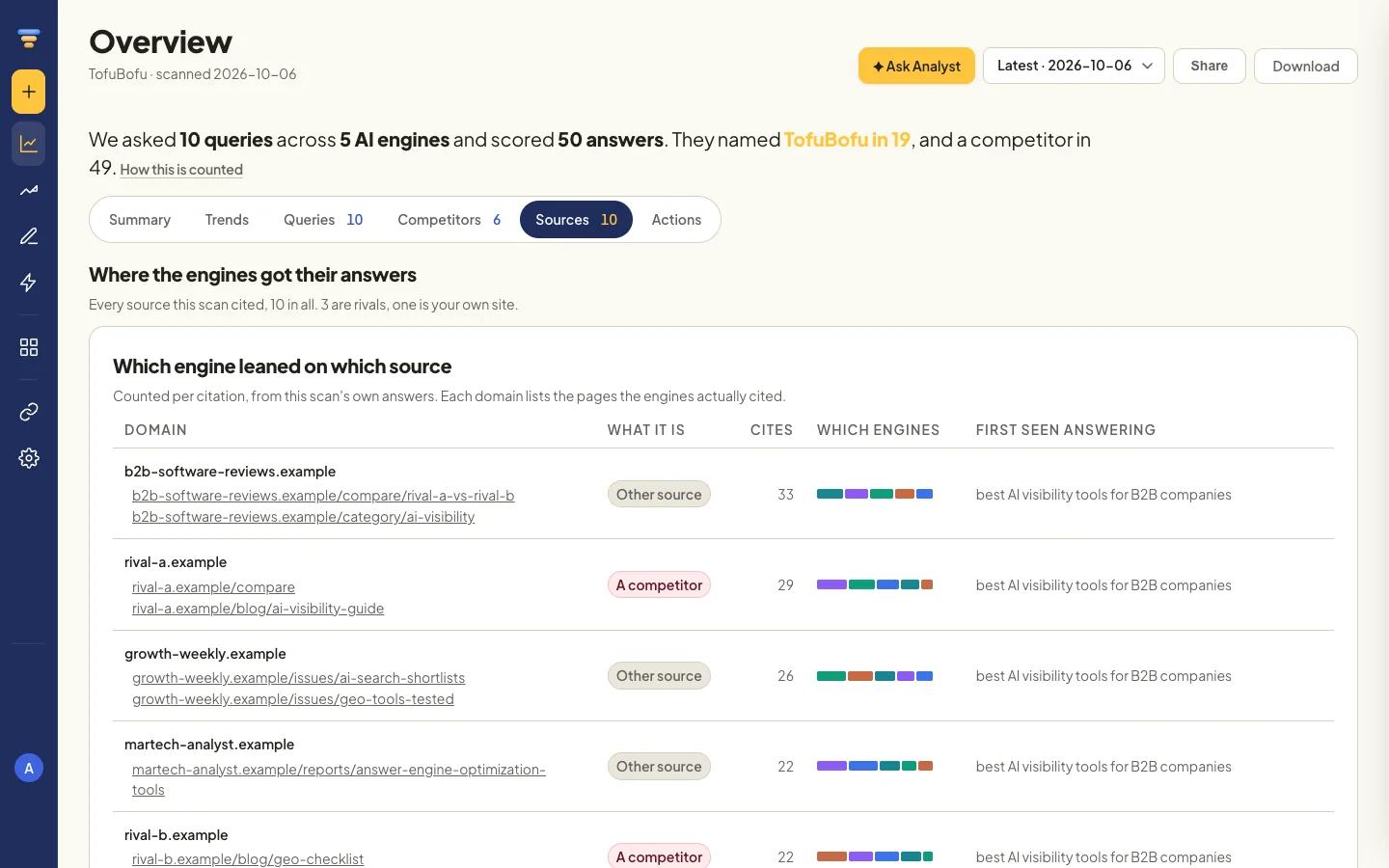
The pages engines built their answers from.
The domains and the exact URLs each engine cited, which engine leaned on which, and which ones are your rivals' own pages. That is where to get listed.
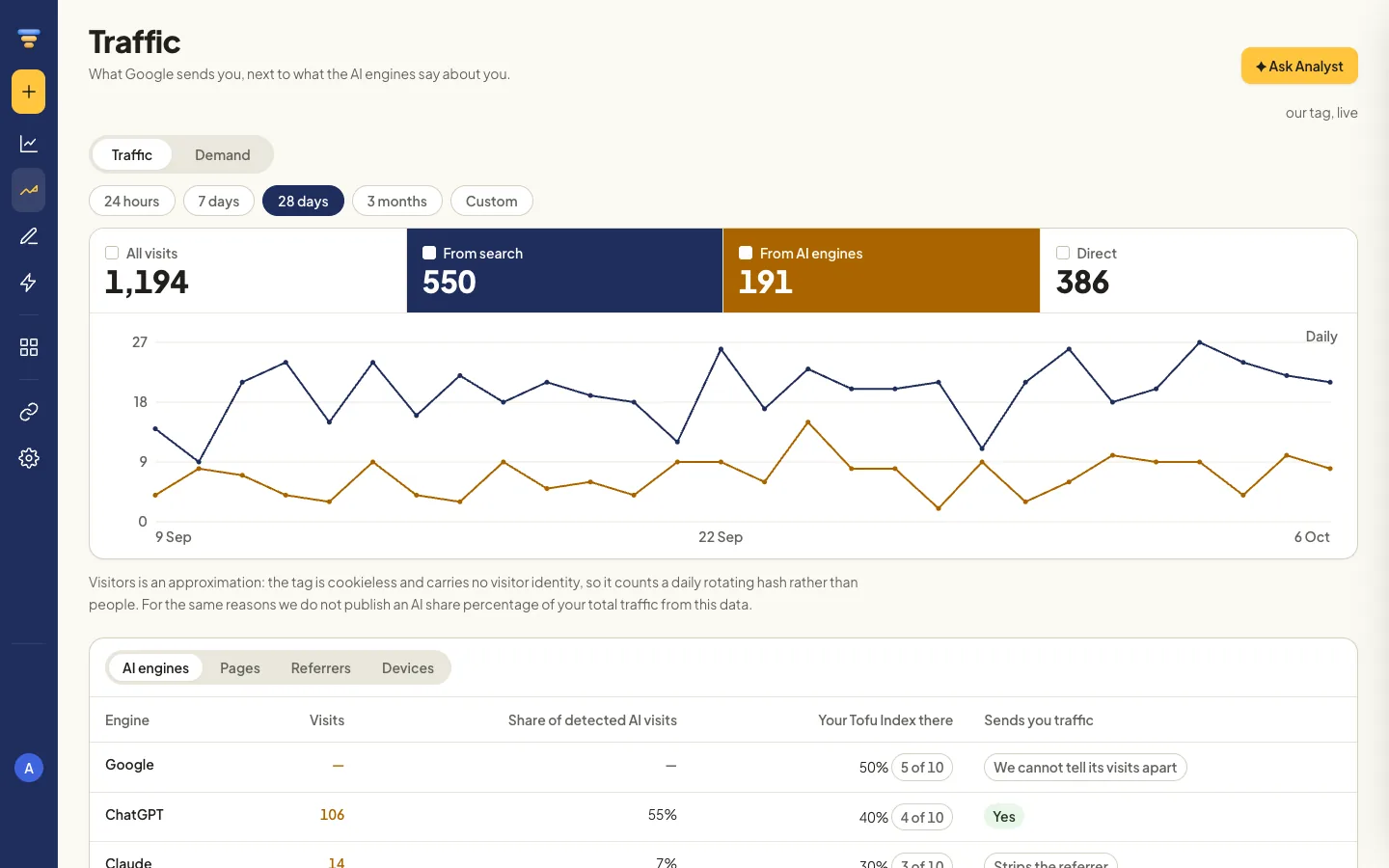
Visits from AI, next to what AI says.
Visits from AI engines and from search, counted by our cookieless tag, beside your Tofu Index on each engine. Connect Search Console and Analytics to add Google's own numbers.
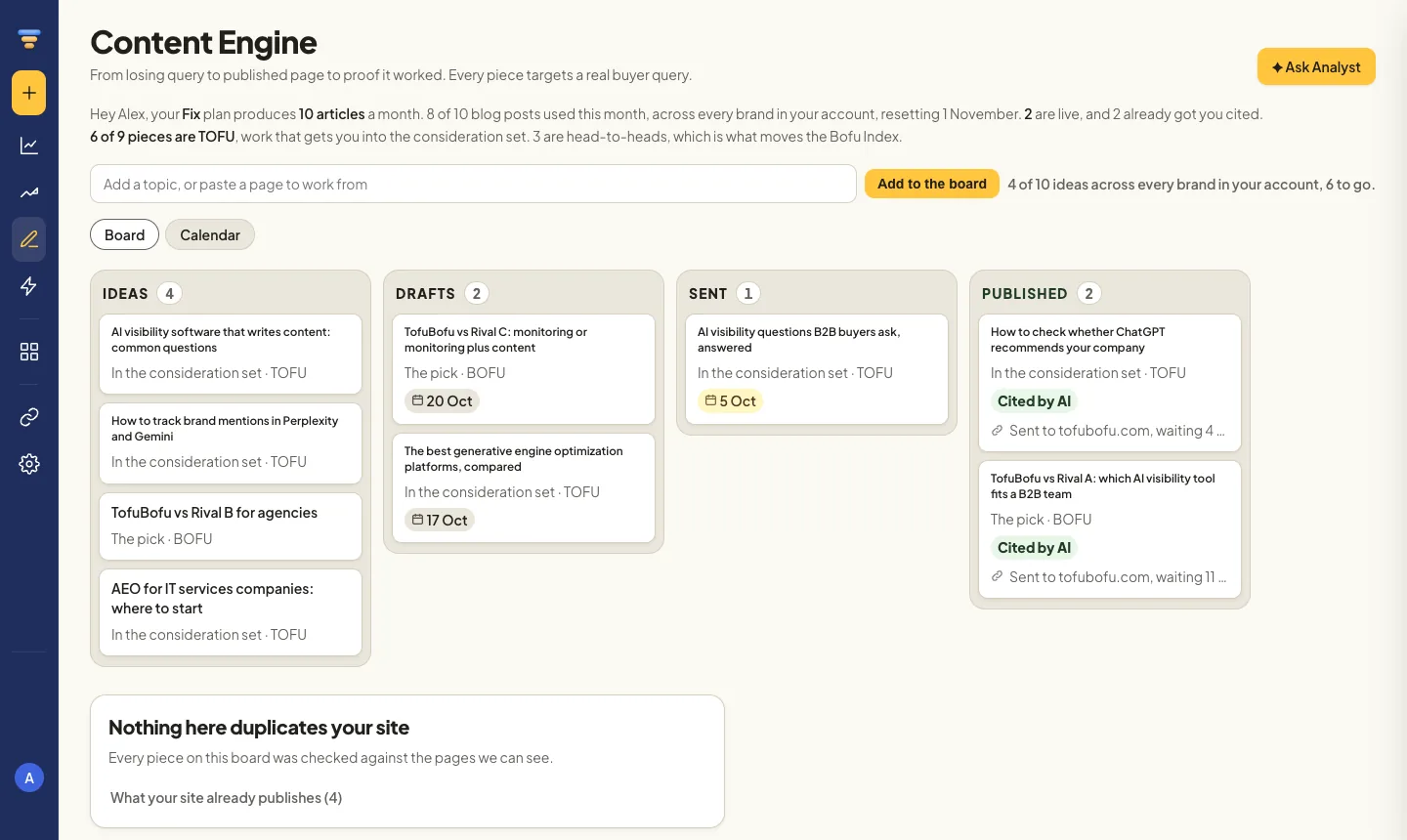
Content written to get cited.
Blog posts, comparison pages and FAQ pages, each aimed at a query you are losing. You approve, it publishes, and a piece is marked Cited once a scan shows an engine naming you for it.
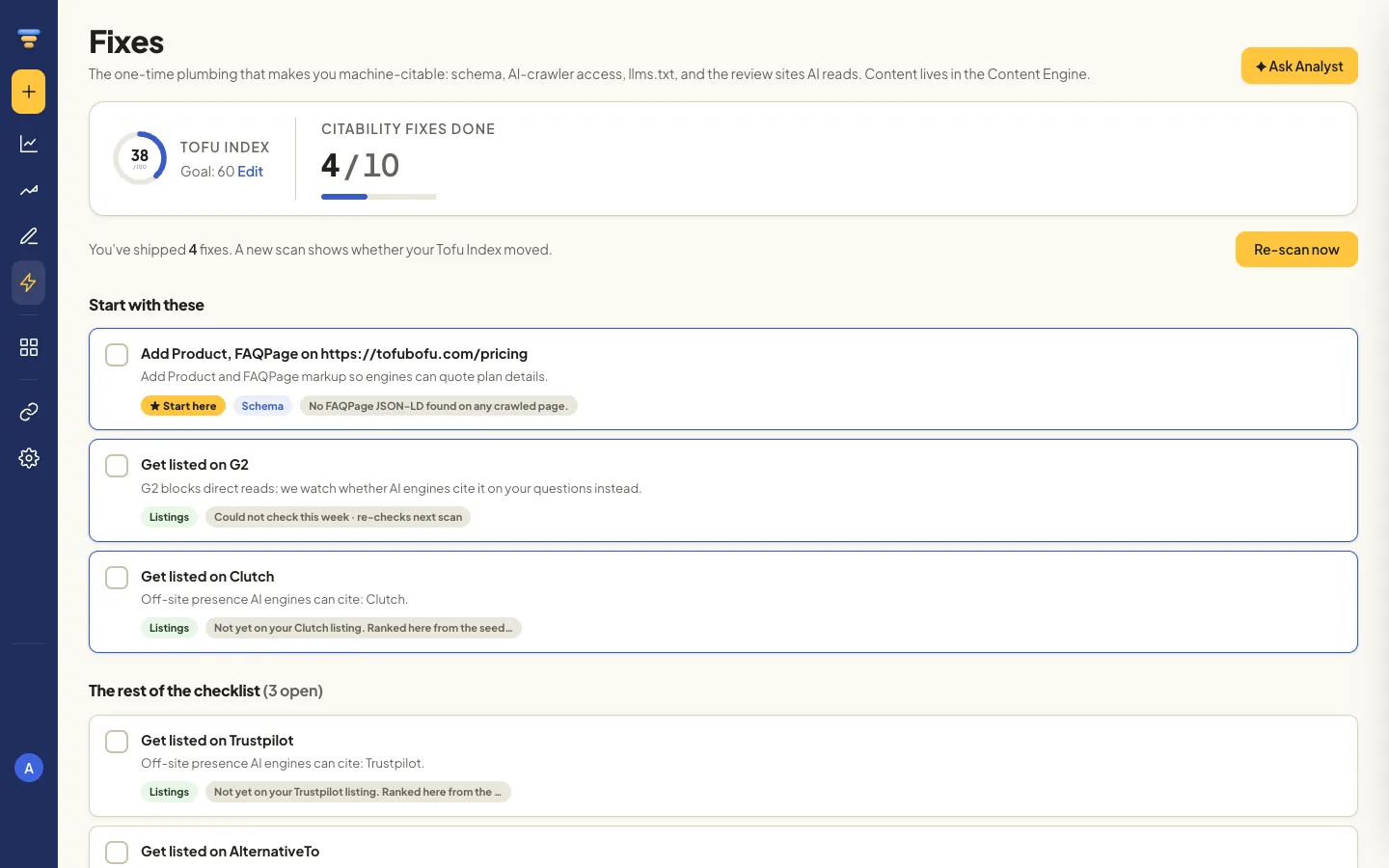
The one-time plumbing that makes you citable.
Schema, llms.txt, AI crawler access and the listings engines read, as a checklist. Tick each off as it ships, then re-scan to see whether your Tofu Index moved.
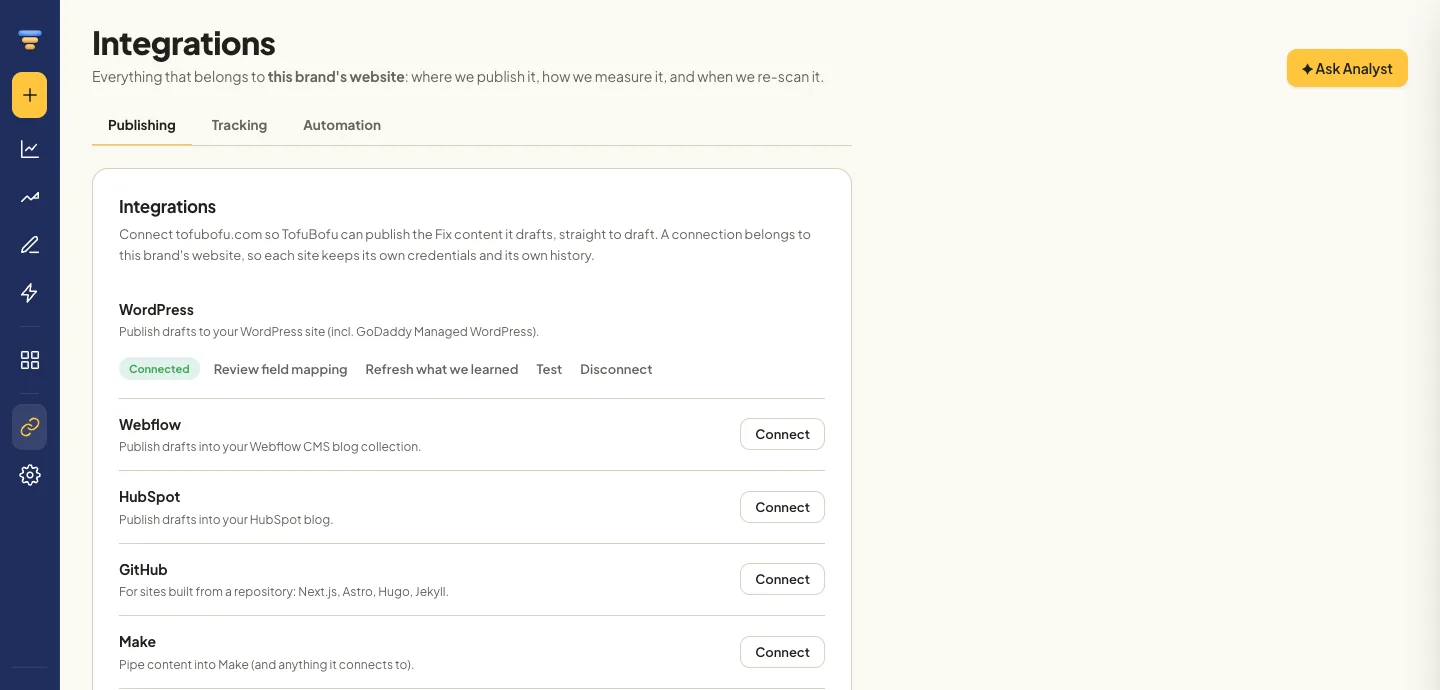
Publish to your own site.
Connect WordPress, Webflow, GitHub, HubSpot or a webhook once, and approved drafts go to your site. Nothing goes live without your approval.
See these screens filled with your own brand.
Check your AI visibility free →Ask your AI visibility a question. Get an answer, not a dashboard.
It sits on every screen and answers in plain language from your own scans: your queries, rivals, trend and content pipeline. If the answer is not in your data, it says so.

“Why did my AI Visibility Index move?”
It names the queries that flipped and the engine that flipped them.
“What should I fix first?”
It starts with the queries where a rival is named and you are not.
“Why does ChatGPT pick them?”
It quotes what the engine said when it left you out.
Inside Claude or ChatGPT too: our MCP server and GPT run a scan from the chat you already use. Set it up →
AEO and GEO content, written to get cited, not liked.
Every draft starts from a buying query where an engine named a rival instead of you. No social posts, no engagement bait: pages an engine can lift a passage from and quote, at the top of the funnel and the bottom.

We draft
Publish-ready, in your voice, aimed at the exact query you are losing, with the structure engines quote: self-contained sections, FAQ, schema.
We publish
You approve once and it goes live on your own site through WordPress, Webflow, GitHub, HubSpot or a webhook. Nothing moves without your approval.
We prove it
The next scan is the referee. A piece is marked Cited once it is live and your latest scan has an engine naming you on the query it targets.
We do not write Reddit, X or LinkedIn posts for you. When an engine cites a thread or a newsletter in your category, the Sources view shows you the exact URL, so you know where taking part yourself is worth the time.
Four steps, running on a loop

See the answers your buyers see
Your buyers’ queries put to every engine, each searching the live web. A model reads every answer and decides whether you were named, and whether you were picked.
Remove what blocks you
Missing schema, silent llms.txt, pages no engine can quote: found by the scan and turned into checkable tasks.
Push it live from the same product
Approve a draft once and it publishes to your own CMS. Nothing moves without your approval.
The next scan is the referee
A piece is marked Cited once it is live and your latest scan has an engine naming you on the query it targets.
It fits the stack you already run
We do not just tell you what to fix. We publish the fix into your own site, and we read your own numbers back.
- WordPress Drafts land as posts
- Webflow Straight into your CMS
- GitHub Pull request to your repo
- HubSpot Into your CMS
- Search Console Read only
- Analytics Read only
- Claude Over MCP
- ChatGPT In the GPT Store
- Zapier 10,000+ apps
- Make 3,000+ apps
Track. Fix. Dominate.
Most tools charge you to watch a number. We hand you that free, then fix what it finds. You only pay to become the name AI recommends.
See exactly where AI leaves you off the list.
- Free forever: one full scan a month
- 5 queries per scan across all 5 AI engines
- Your AI Visibility Index (the Tofu half), and who AI names instead of you
- Competitor comparison, no card
Become the answer AI gives.
- 10 queries per scan, all 5 engines, scanned weekly
- Fixes: schema, structure, AI-bot access
- The Bofu Index: head-to-head with the rivals you track
- 10 articles a month: blogs, comparisons and guides, built for engines to quote
- We draft it; you review and publish
Fix at full volume, with video and newsletters.
- 25 queries per scan, 25 articles a month, plus 10 video scripts and 4 newsletters
- Up to 5 brands on one subscription
- Priority support and onboarding
- You still review and publish
Our read, from our own scans: engines describe you from your own site, but decide from what others say about you. Fix and Dominate write the pages on your site and show you which outside sources the engines lean on.
“Can’t I just ask Claude?” Claude is the brain. TofuBofu is the eyes, the hands and the memory.
Claude is brilliant, and it can search the web. What it cannot do is see what Google AI Mode, ChatGPT, Gemini or Perplexity tell your buyers, publish the fix on your site, or remember last month’s answers to prove the fix worked.
Insight is cheap. The system that acts on it and proves it worked is the product.
The eyes
Your buyers’ queries put to every engine, live, and every answer read. Claude can only guess what the others say.
The hands
The page written in your voice and published to your CMS once you approve it. Claude hands you a to-do list.
The memory
Re-scans on a schedule, weekly on paid plans, and a page marked Cited once an engine names you for its query. A chat forgets.
Built for B2B founders.
Watching every engine your buyers use.
You win on expertise and reputation, not ad budget. Your buyers now ask AI whom to trust, and TofuBofu makes sure the answer includes you, whether you sell software or services. Each industry has its own playbook.
Every scan asks all five engines, each searching the live web first. G2, Clutch and YouTube, the third-party sources engines read for B2B, each have a guide too.
Frequently asked questions
What does TofuBofu mean?
TofuBofu is named after the two ends of the B2B marketing funnel. TOFU, top of funnel, is when a buyer first realises they have a problem; BOFU, bottom of funnel, is when they pick a vendor. An AI engine now answers both in a single reply, naming three vendors before the buyer opens a website, so the top and bottom of the funnel collapsed into one moment. TofuBofu measures whether you are named in that moment across ChatGPT, Claude, Perplexity, Gemini and Google AI Mode, then builds the content that gets you named. The full model, MOFU (the comparison stage) included, is at https://tofubofu.com/tofu-mofu-bofu.
What is AEO and GEO?
AEO (Answer Engine Optimization) and GEO (Generative Engine Optimization) get your company recommended inside AI answers from ChatGPT, Claude, Gemini, Perplexity, and more. SEO optimizes for Google rankings; AEO and GEO optimize for being named when a buyer asks an AI assistant for a recommendation. SEO is the floor, because AI engines search the web and pages that rank help. But ranking #1 on Google does not mean an engine names you.
How does TofuBofu track AI visibility?
TofuBofu asks each of the 5 AI engines (ChatGPT, Claude, Perplexity, Gemini, Google AI Mode) the buying queries your customers ask, and every engine is forced to search the live web first. A model then reads each answer and decides whether it recommends you. That gives your AI Visibility Index in two parts: the Tofu Index, the share of queries where AI names you, and the Bofu Index, the share of head-to-head comparisons against a named rival where AI picks you. A free scan measures your Tofu Index across 5 queries on every engine in about 3 minutes; paid plans add the Bofu Index.
What is the difference between Track, Fix, and Dominate?
Track is free: see exactly where AI leaves you off the list. Fix ($99/mo) builds the citation-ready content that gets you cited, blogs, comparison pages and guides matched to your gaps; we draft it and you review and publish. Dominate ($499/mo) is the same at full volume, plus video scripts and newsletters. You only pay to fix your AI visibility, never just to watch it.
Does AI search visibility actually drive revenue?
Yes: in G2's 2026 research, 69% of B2B software buyers chose a different vendor than they had planned based on what AI told them. One in three bought from a vendor they were not familiar with, and 51% now begin research with an AI chatbot more often than with Google. If AI is not naming your firm, you are losing deals before you know they exist.
Who is TofuBofu built for?
TofuBofu is built for B2B founders whose buyers now start on AI chatbots: B2B SaaS and AI products, plus service firms like IT services, MSPs, cybersecurity, consulting, accounting and agencies. They win on reputation and expertise, not ad budget, so a focused firm can get recommended in AI search without outspending larger competitors. It is a weaker fit for FMCG, pure e-commerce, or enterprise SaaS with a full demand-gen team.
Can't I just do this with my Claude or ChatGPT subscription?
Not really. Claude is the brain, but it cannot see inside the other engines: ask it whether ChatGPT or Perplexity recommends you and it guesses. TofuBofu runs the real queries across all five engines and reads the real answers (the eyes), then writes and publishes the content that gets you cited (the hands). It re-scans on a schedule, weekly on paid plans, so you watch the trend move (the memory) and see the fix proved.
I'm a non-technical founder. Can I actually use this?
Yes, it is built for exactly that. Paste your website and TofuBofu runs the scan, then explains the result in plain language. Every page in the app has a built-in Analyst you can talk to: ask why your AI Visibility Index moved, which query to fix first, or what a competitor is doing, and it answers from your own data. No dashboard to decode, no jargon: if you can describe your business in a sentence, you can use it.
Do you actually fix my AI visibility, or just tell me what is wrong?
We fix it. Most tools stop at a dashboard: they show you the gap and leave the work to you. TofuBofu turns each gap into publish-ready content in your voice (blogs, comparison pages, guides) for the exact buying queries where AI leaves you off the list. It publishes to your CMS once you approve, then re-scans to prove the answer changed: measure, fix, prove, in one place.
Can I use TofuBofu inside Claude or ChatGPT?
Yes. TofuBofu runs an MCP server: add it as a connector in Claude and other MCP-capable assistants, then run a free AI-visibility scan for any company inside the chat, with no separate login. Give it a website and your email, and it runs the real queries across the engines and reads back who gets named. It is the fastest way to check yourself, or a prospect, without leaving the conversation.
How is this different from hiring an SEO or AEO agency?
An agency sells you effort and a monthly retainer, and you mostly take their word that it is working. TofuBofu sells one measurable outcome, being named in AI answers, and you watch the number move in the same tool any day. No 12-month contract, no vague brand-awareness report: if it is not moving, you see it before we do and can walk. You get the doing of an agency with the transparency of a product.