The measurement layer
Does AI recommend you? Are you considered, and are you picked
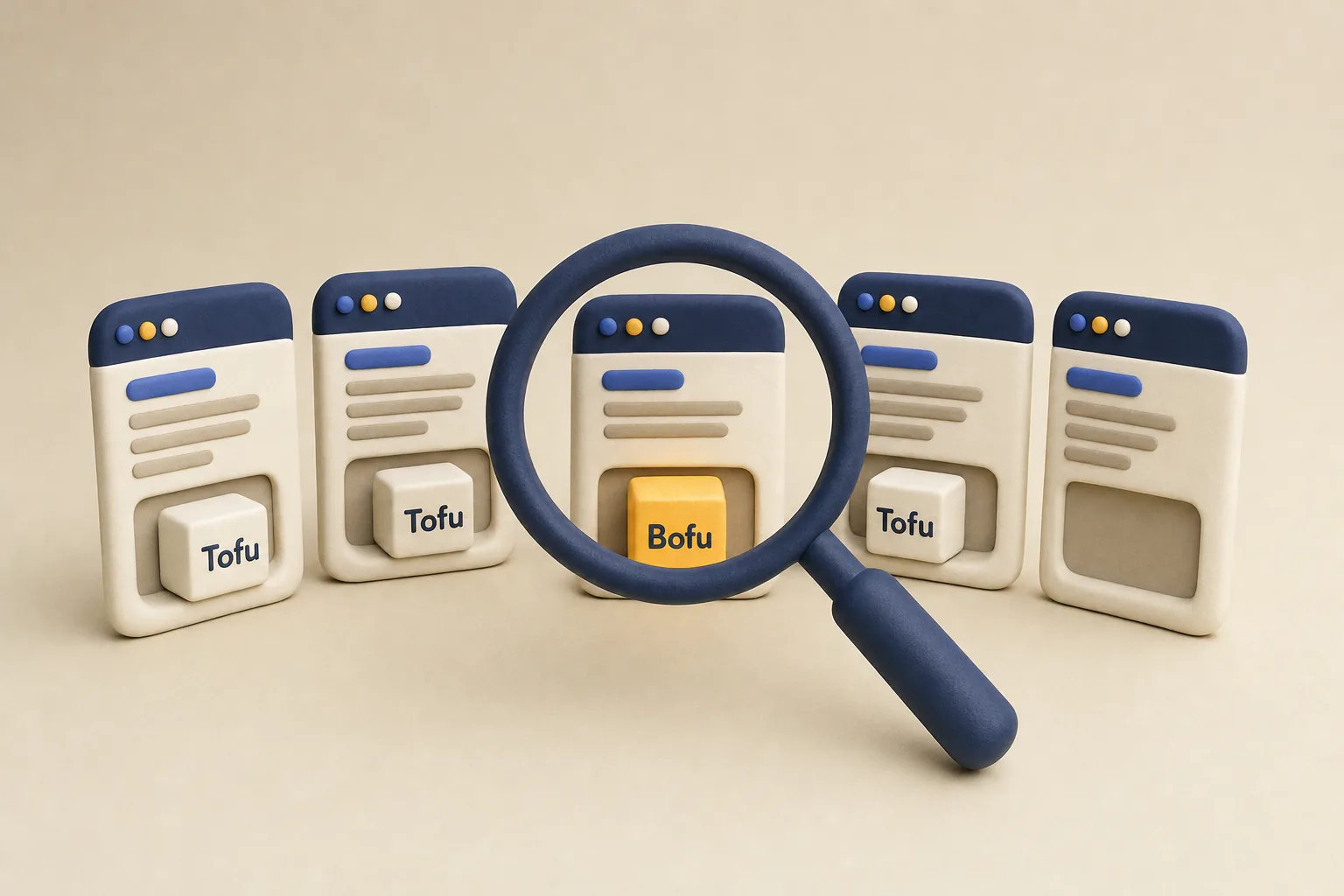
AI visibility is whether an engine names you when a buyer asks for a company like yours. The scan asks your buyers' queries on all five engines and returns your TofuBofu AI Visibility Index.
Every plan queries all 5. See how each engine picks who it names
One Dominate scan
queries: 25 buying queries across five engines, each answer read in full and counted once. That is the Tofu Index denominator, before engines that returned nothing leave it.
The gap this closes
- No rank to check and no console to log into: an engine gives one answer, three names, and no page two.
- Being mentioned and being picked are different outcomes, and one number hides the difference.
- The cause is often plumbing: 16 of 39 readable crawls carried no schema an engine could parse, on firms who already suspect they are missing.
- Nothing tells you any of this. There is no error message for being left out.
What you end up with
- Your Tofu Index: the share of queries, across all five engines, where you are named.
- Your Bofu Index on paid plans: the share of head-to-head comparisons where you are picked.
- Every answer stored word for word, and who was recommended in your place.
- A fixed query set, so next month's scan is a comparison and not a fresh guess.
How it works
Three steps, and you only do the first one.
You confirm the queries
Research reads your site and drafts the buying queries your market asks. They are localized when your market is local. You edit them before anything runs. Every later scan re-asks the same confirmed set, so your trend line compares like with like.
Five engines answer, and we read the text
ChatGPT, Claude, Perplexity, Gemini, Google AI Mode each get every query. Each is forced to search the live web first. Every answer is stored in full and checked for your brand, including domain-style and spaced variants. An engine that returns nothing is recorded as no signal, never as a brand that went unnamed.
Two numbers come out, and the gaps get ranked
The Tofu Index counts the queries where you were named. On paid plans, the Bofu Index counts the head-to-head comparisons you won. Queries where a rival was named and you were not become an ordered list. On a paid plan, that list is the brief the Content Engine writes against.
What you get on each plan
A scan is a delivered report, not a dashboard you have to operate. Query counts, scan cadence and drafting volume on the cards read live from the plan configuration.
Track
Free- One scan a month, no card
- Your Tofu Index across every engine
- Every engine's answer in full, and who was named instead
- A ranked list of the queries worth chasing first
- The Sources pane: the ten domains the engines cited most
- A shareable link that outlives the month
Fix
$99/mo- Weekly scans and a wider query set
- The Bofu Index, from head-to-head comparisons with your rivals
- Adaptive sampling: a third call only when two answers disagree
- Losing queries turned into drafts, up to your monthly cap
- Alerts when an index moves or a query is lost
Dominate
$499/mo- The full query budget, same five engines
- Video scripts and newsletter issues off the same scan
- Head-to-head detail per competitor
- Priority support
Rule
$1999/mo- Dominate's numbers, with our team doing the work
- For a firm with nobody in-house to implement
- Sales-assisted, scoped on a call
Rule carries Dominate's numbers with our team doing the work, and is sales-assisted.
The proof, including the parts that flatter nobody
We publish our own scan numbers, a habit worth being suspicious of until you can see the method. The sample is firms that suspected they had a problem before they ran anything.
Across the 46 completed reports behind this page, Perplexity named the brand in 7.4% of the buying queries we put to it, on those firms that suspected a problem.
Every other engine landed between 0.4% and 4.0%, on the same firms that suspected a problem.
The engines are also less settled than a single check suggests. In July we asked four of them to name managed IT providers across 15 North American regions.
In that managed IT study we resolved every name they produced to a real website, and could corroborate 115 of 566.
That is one profession over one fortnight. The full method, including what we could not verify, sits on the research page.
Read the MSP AI Visibility Report 2026 →A worked example: one row of the record
A report is a table of queries by engines. This is one buying query's row of it. The brand and the answers are illustrative, written to show the shape. The fields are the fields the report stores.
Buying question: best managed IT provider for a healthcare clinic in Ohio
| Engine | Verdict | Named instead | Evidence |
|---|---|---|---|
| ChatGPT | Absent | Vendor A, Vendor B, Vendor C | Full answer stored, plus the pages it cited |
| Claude | Absent | Vendor A, Vendor D | Full answer stored, plus the pages it cited |
| Perplexity | Named, in passing | Vendor A, Vendor B | Named in a list of five, no detail |
| Gemini | No signal | The forced search did not fire, so this cell leaves the denominator | |
| Google AI Mode | Absent | Vendor A, Vendor E | Answer plus its reference links |
What the row adds to the two indices
- Tofu Index: four of these queries were answered and one named you, so the row adds 1 to the numerator and 4 to the denominator.
- Vendor A, named on three of the four answers, becomes a tracked rival whether or not you declared it.
- On a paid plan, Vendor A is one of the rivals in the head-to-head probe that produces your Bofu Index.
- A content brief aimed at this exact phrasing, drafted on a paid plan and listed as an idea on the free one.
- A row in the next scan's comparison, because the question is held still and re-asked.
Multiply that by every buying query in your plan and all five engines. That is the record both indices are computed from. The index is the summary. The row is the evidence, and every number on the report traces back to one.
How it actually works
The mechanism, for anyone who wants it. Open a card to read the detail.
The two indices, and what each one divides by
AI visibility is the outcome AEO and GEO exist to move. Your TofuBofu AI Visibility Index measures it as two numbers that follow the funnel, never blended.
Read the detail
- A query is one question put to one engine. Each engine gives its own answer, and each answer can name you or not.
- So the same question asked of five engines is five queries.
- On Dominate: 25 buying queries across five engines, 125 queries in all.
The Tofu Index answers one thing: are you getting mentioned.
- It is the share of answered queries where the engine named you, fully or in passing.
- An engine that returned nothing leaves the denominator.
- So does an answer that recommended no vendor at all. Neither is an absence you could have prevented.
The Bofu Index answers the other thing: when a buyer narrows to two, are you the pick.
- It is a separate probe with its own denominator.
- For each of up to five rivals, every engine chooses between you and that rival.
- The name order alternates, so position bias cancels.
- Five rivals across five engines is 25 comparisons. The index is the share settled in your favour.
- The probe runs on paid plans, where sentiment is on. A free scan reports the Tofu Index alone.
Both numbers count answers rather than questions. Fewer engines or fewer queries shrink the numerator and the denominator together. A rival's Tofu Index is computed exactly like yours, so the two are directly comparable.
Every engine we query searches before it answers
Every engine we query is forced to search the live web before it answers. An answer where the search did not fire is recorded as no signal, never as your absence.
Read the detail
The reason: an engine answering from memory can produce a confident vendor name with no page behind it. A low score against that says nothing about your website.
It was not always true, so the dates matter if you are reading an old trend line:
- ChatGPT has run with forced retrieval since 18 August 2026.
- Claude since 28 August 2026.
- Gemini since 1 October 2026.
- Perplexity and Google AI Mode retrieve natively.
Scans either side of a cutover measure different instruments. The report says so instead of drawing one smooth line through them.
Retrieval is also why the scan can be acted on. An engine that searched first can cite a page. The Sources pane lists the ten domains the engines cited most for your queries, with the cited URLs underneath. That is where you see which pages, directories and threads are quoted to your buyers.
Why one check is an anecdote
Ask the same query twice and a model can give you two different vendor lists. That variance is why a screenshot proves nothing.
Read the detail
- The paid tiers ask each query twice.
- They pay for a third call only when the first two disagree.
- A verdict that survives disagreement is worth recording.
The other half of the discipline is holding the queries still. Regenerating the set between scans destroys a trend line:
- Two consecutive scans of one firm once shared no queries at all.
- An 8% reading followed by 0% looked like a collapse. It was two different tests.
- Repeat scans re-ask the set you confirmed.
- They add to it when your budget grows, and trim from the end when it shrinks.
What the crawl sees that no answer can tell you
Every scan also fetches your site and records what a machine reading it would find. That crawl turns a gap in the answers into an instruction you can act on this afternoon.
Read the detail
- It walks your sitemap.
- It records which schema types you serve.
- It checks whether an llms.txt file exists.
- It lists which topics you have already published.
The crawl also has to be honest about its own failures. One domain answered our crawler with an HTTP 444 and a browser with a 200. A report would have told a real prospect they published nothing, while their sitemap listed 676 URLs.
- The crawler now identifies itself with a contact address.
- A site we could not read is reported as unread instead of empty.
See where you stand first
Run a free scan and find out which of these gaps you actually have.
Get your free auditFrequently asked questions
Which engines does the scan cover?
All five: ChatGPT, Claude, Perplexity, Gemini, Google AI Mode. Engines are not plan-gated, so a free scan asks the same five a Dominate scan asks. What the plan changes is how many queries you get, whether the Bofu Index runs, and how many times each query is sampled.
What is the AI Visibility Index?
The TofuBofu AI Visibility Index is how we measure AI visibility, in two parts. The Tofu Index asks whether you are in consideration: the share of queries where an engine names you. The Bofu Index asks whether you are the top choice: the share of head-to-head comparisons against a named rival where the engine picks you. We always report the pair and never average them, because a firm can be on every shortlist and lose every head-to-head.
What is the Tofu Index?
The share of queries, one question put to one engine, where the engine named you, out of the queries that were answered. Engines that returned nothing, and answers that named no vendor at all, leave the denominator. It tells you whether you are in the consideration set.
What is the Bofu Index?
The share of head-to-head comparisons, you against one named rival on one engine, where the engine picked you. Up to five rivals across every engine, with the name order alternated. It tells you whether you are the pick once a buyer narrows to two. It runs on paid plans.
Does the free scan give me both numbers?
No. A free scan gives you the Tofu Index across every engine. The head-to-head probe behind the Bofu Index runs on Fix, Dominate and Rule.
Why does my scan differ from what I see when I ask ChatGPT myself?
Because your chat is one sample from a system that varies, and it knows you. Your history and your custom instructions shape the answer you get. The scan asks neutral buying queries from a clean context, forces a web search, and verifies the answer text server side, so it reflects what a stranger sees.
Does running a scan change my AI visibility?
No. The scan observes. It never touches your site or signals an engine, and the indices move only when the underlying answers move.
Sources and further reading
- G2 2026 AI Search Insight Report: 51% of B2B software buyers begin research on an AI chatbot more often than Google; 69% chose a different vendor than planned based on AI guidance.
- Lewis et al. 2020, Retrieval-Augmented Generation (arXiv:2005.11401): The foundational paper describing how models retrieve from an external, non-parametric memory to generate factual, sourced answers.
- SE Ranking, structured data in AI answers (via Search Engine Land): 71% of pages ChatGPT cites include structured data; 65% for Google AI Mode.
Related solutions