Only counts once it is text
An episode with no transcript does not exist to an AI engine
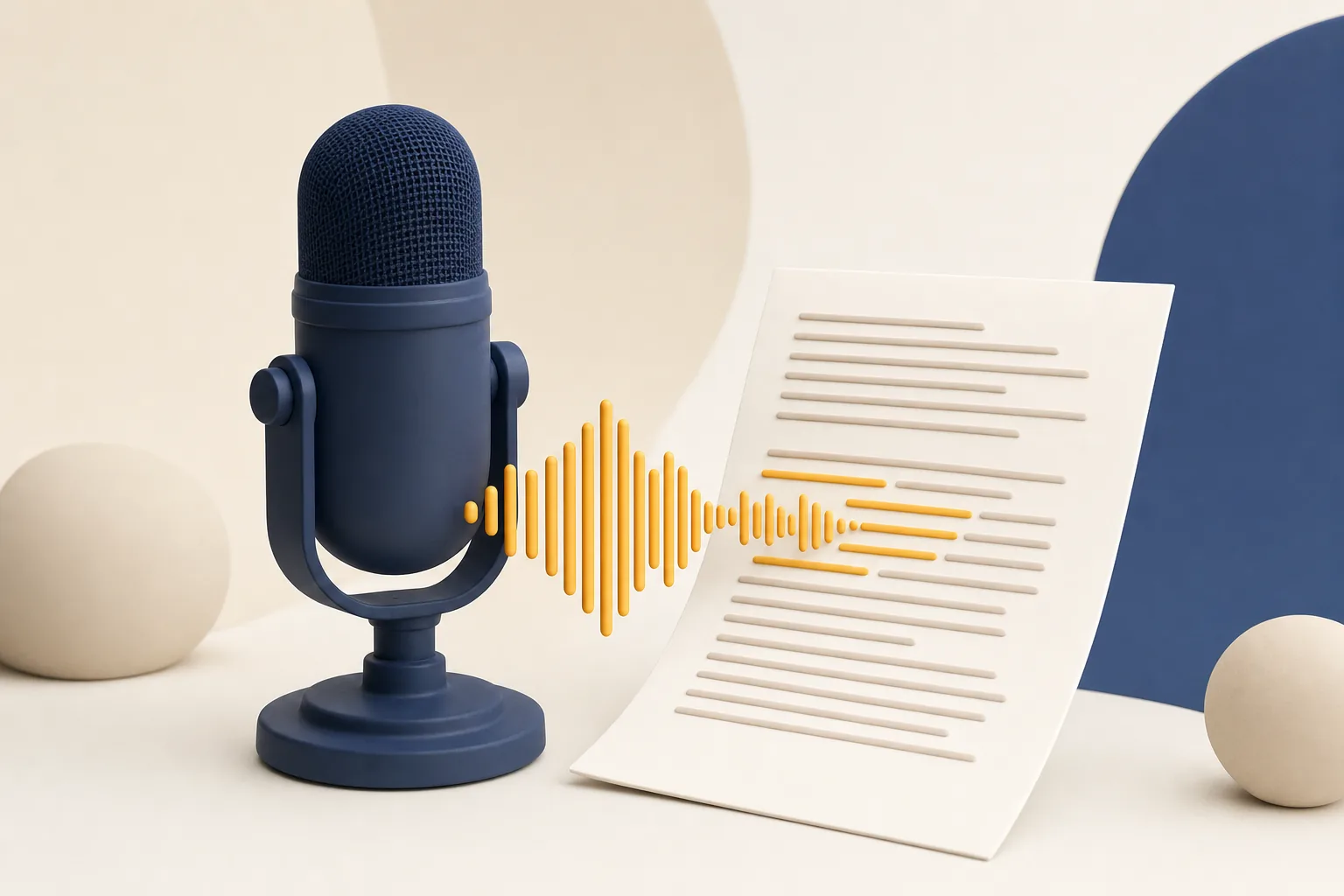
A forty-minute conversation is the richest expert material most firms produce, in the least readable form. Engines read text, so an episode counts only once its transcript is a page.
Every plan queries all 5. See how each engine picks who it names
The buyer behind the listener
as many B2B buyers name AI as a top information source as did before (Forrester, 2026). None of them are listening to your episode when they ask.
The gap this closes
- Episodes are published to a hosting platform and left there.
- The episode page is a player, a paragraph and a link out: nothing an engine can read.
- A raw transcript is barely better: forty minutes of prose with no structure.
- Topics are picked by what the host finds interesting, not by what buyers ask.
What you end up with
- An episode list built from the buying queries you lose.
- On Dominate, scripts whose beats are a ready outline for the conversation.
- A clear shape for the transcript page that makes an episode readable.
- Stated plainly: we do not produce, transcribe or write up your podcast.
How it works
We pick the conversation. You record it and publish the text.
The episode targets a query you lose
We do not produce podcasts. We tell you which conversations to have. Episode subjects come from the same ranked list as everything else: buying queries where an engine named a rival. The verbatim answers tell you which criteria the conversation must cover.
The script is the outline
On Dominate the Content Engine drafts a video script for the query, with the opening written out and the beats in order. It doubles as an episode outline. Recorded as audio or video, it keeps the conversation on the points an engine needs.
You publish the transcript as a page
Transcribe the recording and publish it on your own domain as a structured page, with the player embedded underneath. That page is thousands of words a machine can quote. The next scan re-asks the query on all five engines, and the crawl reports whether the page carries structure.
What you get on each plan
Read this part carefully, because it is where most vendors would overclaim. There is no podcast generator in the Content Engine and no show-notes writer. What each plan gives you is below.
Track
Free- Buying queries where a rival was named instead of you, ranked
- The verbatim answers, which tell you what the episode must cover
- An episode list for the year, ordered by what matters to a buyer
- The crawl reports whether your episode pages carry any structure
Fix
$99/mo- Video briefs on the report: a hook and a beat-by-beat outline
- Blog, FAQ and comparison drafts for the same queries
- A written page on your domain the episode can sit beside
- No podcast drafting, no show notes, no transcription
Dominate
$499/mo- Finished video scripts whose beats double as episode outlines
- Newsletter issues that carry the argument in writing
- The wider query budget gives you more episodes worth recording
- No audio production, said before you buy
Rule
$1999/mo- Dominate's numbers, with our team doing the work
- We plan which conversations are worth having
- Recording and transcription stay with you
No plan produces, transcribes or writes up a podcast. Rule carries Dominate's numbers with our team doing the work, and is sales-assisted.
The proof, including the parts that flatter nobody
We have no first-party measurement of podcast outcomes and will not manufacture one. Nothing in the product instruments an audio platform.
The evidence we do have is the starting line. Across the 46 completed reports behind this page, Perplexity named the brand in 7.4% of the buying queries we put to it, on firms that arrived already suspecting they were missing.
Every other engine sat between 0.4% and 4.0%, on the same firms that suspected they were missing.
The test we can run is the one we run everywhere. The query the episode answered is re-asked on all five engines every scan, and the crawl reports whether the page you published is live and structured.
Read the MSP AI Visibility Report 2026 →A worked example: the show-notes page
The structure of a page built from one episode about after-hours IT coverage. The brand, the guest and the number in the quote are illustrative. The firm wrote the page; the episode topic came from a query its scan showed it losing.
Page skeleton
- H1: Can an outsourced provider really cover a plant at 2am? Episode 14 with a plant manager who tried it.
- Summary in four sentences: the query, the answer, who is arguing it, and the one thing that surprised us.
- Chapters as H2 headings with timestamps: Who picks up at 2am / What a response window means / The escalation number nobody asks for / What went wrong in month two.
- Three pull quotes, each complete on its own, attributed to the speaker.
- An FAQ block of five pairs, marked up and visible.
- The cleaned transcript under its own heading, with the player embedded below the text.
One pull quote, as it appears
"The number that told us the truth was how many after-hours
incidents they closed last quarter without waking one of our
people. They had it. Nobody had ever asked them for it."
That quote survives extraction. It names a situation and a test a reader can apply, and an engine quoting it needs none of the surrounding forty minutes.
Everything above is one writing task per episode. It is the difference between a podcast that builds an audience and one that also builds a body of text the engines can read.
How it actually works
The mechanism, for anyone who wants it. Open a card to read the detail.
Audio is invisible until it is text
Engines read documents. Every engine we query searches the live web before it answers, and what it retrieves is text.
Read the detail
- An audio file is not text.
- Forty words of description under a player is not enough to answer anything.
- So an episode with no published transcript contributes nothing to any answer about you.
The upside is proportionate. Long conversations go into detail that written content skips, because a guest was asked a follow-up and answered honestly.
Those passages, the edge case or the scenario nobody writes a blog post about, are what an engine needs when a buyer's query carries a qualifier.
So the value per hour is high, provided the last step happens. An episode you record and do not publish as text is work done only for the listeners you already had.
The page an episode has to live on
Put the episode on your own domain as a readable page, and embed the player inside it. Host platforms will not do the job:
Read the detail
- They are built for players and subscriptions.
- Many render through scripts a crawler never runs.
- None give you markup or internal links.
The page needs five things, all cheap:
- A summary near the top that states the query and the answer.
- Chapter headings phrased the way a buyer would ask.
- Two or three pull quotes that make sense on their own.
- An FAQ block covering the questions the conversation answered, marked up and visible.
- The cleaned transcript underneath, with speaker labels.
Skip the markup and the page still helps a reader. Skip the structure and it helps nobody, because a wall of transcribed speech is the least extractable text on the web.
Guest appearances beat your own feed
Given the choice between recording an episode and appearing on somebody else's, take the appearance, provided the host publishes a transcript.
Read the detail
Their show notes on their domain, with your name and your argument in them, are corroboration from a source you do not control.
Corroboration is what an engine checks before it names a vendor. A guest spot is one of the few ways to add an independent source without asking for a favour nobody will grant.
The preparation is the same either way:
- Take the query you lose.
- Decide the three checkable specifics you want in the transcript.
- Say them plainly enough to survive being quoted.
A host with no transcript gives you listeners and nothing an engine can read.
Video is the same rule with a better host
Everything here applies to video, with one difference in your favour. YouTube transcribes for you, and it sits inside Google, whose AI Mode is one of the engines we query.
Read the detail
A video with a clean transcript and a written description is indexed text on a domain you could never build.
That is why the Content Engine drafts video scripts and not podcast episodes. A script is written for the transcript:
- The query stated aloud, the answer straight after.
- Each beat a passage that stands alone.
- Recorded as a podcast, the same script gives you a structured conversation.
- Published on YouTube, it gives you the transcript too.
See where you stand first
Run a free scan and find out which of these gaps you actually have.
Get your free auditFrequently asked questions
Do you produce or write up my podcast?
No. There is no podcast generator in the Content Engine and no show-notes writer. We give you the queries worth an episode and, on Dominate, video scripts whose beats double as an outline. Recording, transcribing and publishing the page are yours.
Does a podcast help AI visibility at all?
Only once it is text. An episode with a structured transcript page on your own domain is thousands of words an engine can read. An audio file on a host platform contributes nothing.
Why does the transcript have to be on my domain?
Host platforms are built for players. They often render through scripts a crawler never runs, and give you no markup or internal links. Embedding the player in your own page gets both the listener and the readable text.
Should I start a podcast or a YouTube channel?
If you are choosing, YouTube: it transcribes for you and sits inside Google, whose AI Mode is one of the engines we query. The same script works as either.
Does audio quality matter?
Only through transcription accuracy. A clear, on-topic conversation beats a studio recording that circles its point.
Sources and further reading
- Forrester B2B Buying Study 2026: 94% of B2B buyers use AI in the buying process; 2x now cite AI as a top information source.
- Lewis et al. 2020, Retrieval-Augmented Generation (arXiv:2005.11401): The foundational paper describing how models retrieve from an external, non-parametric memory to generate factual, sourced answers.
Related solutions