Decision-stage capture
The pages an engine reaches for when a buyer is choosing
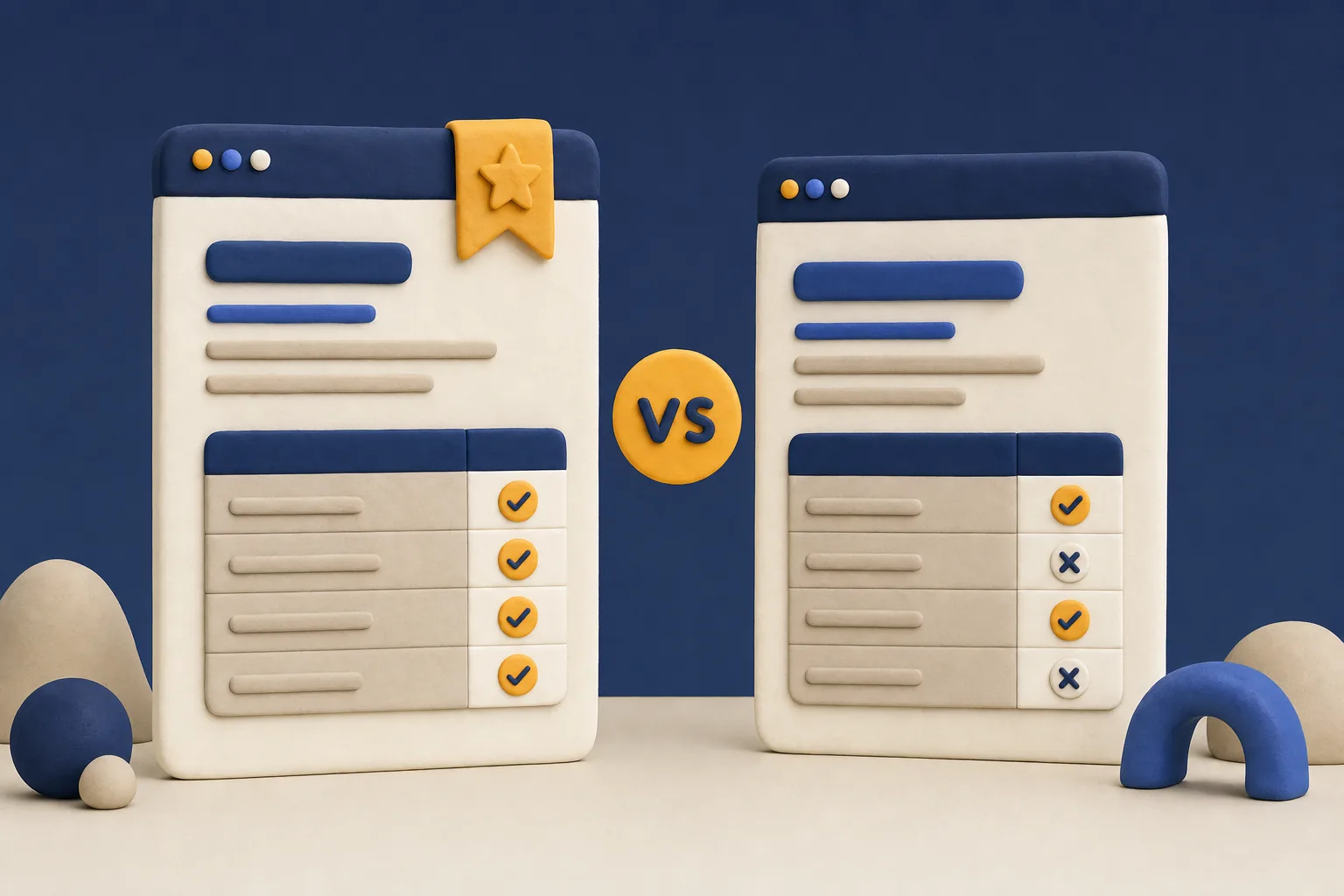
A buyer who has started deciding gets an answer with three or four names in it and no second page. A comparison page is built for that moment.
Every plan queries all 5. See how each engine picks who it names
The number behind this page
of B2B buyers ended up choosing a vendor other than the one they first intended, after an AI recommendation (G2, 2026). The shortlist is where that happens.
The gap this closes
- Only the top of the question hierarchy decides revenue, and that is where firms do not write.
- Decision-stage phrasings sit unclaimed because firms write about their category instead.
- Most firms compare themselves to the wrong companies entirely.
- The set in your pitch deck is not the set an engine puts you beside.
What you end up with
- Head-to-head and alternatives pages drafted against the rivals engines actually named.
- Your real competitive set, taken from the answers rather than from your deck.
- Pages aimed at the decision-stage phrasing a buyer uses when they have stopped learning.
- Coverage of the questions that produce a shortlist of three or four names.
How it works
Three steps.
The rivals come from the answers
Every scan extracts each firm an engine named in its answer, not just the ones on your watchlist, and scores all of them. A rival named by four engines across your buying queries outranks one you argue with at conferences. The page order follows that ranking.
The criteria come from the engines too
The stored answers say what the engines think matters: prior experience in a vertical, a named compliance lead, response times, minimum contract size. Those become the rows of the comparison table. The page answers the criteria a buyer is being handed, not the ones you would prefer.
The page argues fairly, then the scan referees it
Each page states where the alternative fits better. A page that always declares you the winner reads as marketing, to a buyer and to a system weighing sources. The Content Engine publishes it to your CMS. The next scan re-asks the comparison query on all five engines, and the Bofu Index tells you whether you are now the one picked.
What you get on each plan
You get finished head-to-head and alternatives pages, drafted against the rivals engines named in your place. This is what lands, per plan, with the monthly volume read live from the plan configuration.
Track
Free- No drafting, but you get the part nobody else gives
- Every firm each engine named beside or instead of you
- Including rivals you never listed
- All of them scored, not just your watchlist
- Often the moment you find the market you are really in
Fix
$99/mo- Head-to-head and alternatives pages from the monthly budget
- The mix decided by the scan, not by a quota
- Criteria table built from dimensions the engines raised
- FAQ block covering a deciding buyer's objections
- Next weekly scan re-asks the comparison query
Dominate
$499/mo- Head-to-head detail per competitor
- Questions a rival wins outright, and the ones you win
- The engines doing the naming in each case
- Cover the rival named on four engines before the one on one
- Volume that makes a full competitive set realistic in a quarter
Rule
$1999/mo- Dominate's numbers, with our team doing the work
- We check every claim about a rival against a source
- Publishing to your site only if you grant it
Rule is portfolio level and sales-assisted, and it is the right conversation when competitive sets overlap across brands.
The proof, including the parts that flatter nobody
Our strongest evidence sits in our own managed IT research, and it is about what does not work. Across 15 North American regions we compared what four engines recommended for managed IT against the firms listed in those regions' own Clutch directories.
In that managed IT study, 139 of 228 directory-listed firms were named by no engine at all.
Being present where buyers browse is not the same as being present where a machine reads and quotes. A directory row carries a name and a category. A comparison page carries an argument with criteria in it, and only one of those is quotable in an answer.
What we cannot claim: that a comparison page caused a buyer to switch. The measurable thing is narrower and still useful. The query it targeted gets re-asked on all five engines every scan, and the report shows whether the answer that named a rival started naming you as well.
Read the MSP AI Visibility Report 2026 →A worked example: the table and what it is built from
The core of a page written for a firm that kept losing to a national provider on regulated-industry queries. The brand names are illustrative. The rows are not invented: each one came from a criterion an engine stated in its own answer.
Page: Northlake IT vs Vendor A for a regulated 40-seat firm
| Criterion the engines raised | Northlake IT | Vendor A |
|---|---|---|
| Prior SOC 2 Type II work in professional services | Yes, 14 engagements, two named references | Yes, at enterprise scale |
| Named compliance lead on the account | Yes, one per client | Pooled compliance team |
| Minimum contract size | No minimum | Enterprise minimum applies |
| After-hours response commitment | One hour, contractual | Four hours on standard tier |
| Onboarding time to first audit-ready evidence pack | Six weeks | Twelve weeks |
| Better fit when | Under 100 seats, one regulator, needs a named human | Multi-site, multi-regulator, procurement-led buying |
The FAQ pairs that ship with it, marked up and visible
- Q. Is a smaller provider risky for a regulated firm? A. The risk is evidence, not size, and the five artefacts an auditor asks for are the same either way.
- Q. When is Vendor A the better answer? A. Multi-site and multi-regulator, where a pooled compliance team is an advantage rather than a queue.
- Q. What does switching cost? A. Named as weeks and named as artefacts, with the handover list stated.
Notice what the last row does. Stating plainly where the rival wins makes the other five readable as an assessment instead of a pitch. It is the row most firms refuse to write.
Notice also what is absent: no adjectives about being trusted or leading, no unsourced claims, nothing a buyer would have to take on faith. Every cell is a fact a prospect could check on a call, which is the same property that makes it safe to quote.
How it actually works
The mechanism, for anyone who wants it. Open a card to read the detail.
The shortlist is assembled once, and it is short
A generated answer names three or four firms and stops. Presence is binary: everyone below the cut gets the same result as everyone who never published anything.
Read the detail
A ranked results page is forgiving by comparison. Position eleven still exists, still gets clicks, and can be improved next quarter.
That changes what a comparison page is for. It does not improve a position. It gives a system a reason to include you in a list it was going to write anyway, on a query where it has already decided the answer format is names.
So the phrasing matters more than the volume:
- A comparison built for a broad category term competes with every firm in the category, and the incumbents own it.
- A comparison built for a qualified situation, with the headcount, the regulator and the existing software stack in it, competes with almost nobody.
- It also matches the question a real buyer asked.
Why a fair page beats a flattering one
A one-sided comparison is easy for a system to detect and cheap for it to skip. Every row favours one side, no limitation appears anywhere, and the page reads as an advertisement. A system assembling an answer it has to stand behind reaches for the source that reads as an assessment.
Read the detail
There is a commercial argument as well as a mechanical one:
- A page that names where the alternative fits better loses you buyers you were going to lose anyway.
- It wins the trust of the ones who fit.
- Saying a rival is the better answer for a 500-seat enterprise is no concession if you sell to 40-seat firms. It is the sentence that makes the rest of the page believable.
The line to hold is accuracy. Truthful comparison naming competitors is ordinary practice in B2B; the risk sits entirely in claims you cannot support. Our drafts:
- State facts with a source behind them.
- Frame positioning as positioning.
- Never invent a weakness, which is also the only version an engine is willing to quote.
The competitor set you declare is not the set AI uses
This one surprises people, and it came out of a customer conversation rather than a whiteboard. A founder lists the rivals they lose deals to. The scan records the rivals engines name in the same breath.
Read the detail
When those two sets diverge, the divergence is the finding. The engines are describing how your content positions you, and your buyers are receiving the same signal.
A comparison page is the direct correction. Writing it for the firm an engine keeps pairing you with does two things at once:
- It puts you into the query stream where that pairing already happens.
- It states, in text a machine can read, which situations belong to you and which belong to them.
The alternatives page does the same job from the other direction:
- A buyer unhappy with an incumbent asks for alternatives by name, and arrives frustrated and ready to move.
- The incumbent is never going to write that page about you.
- It is durable. A page tied to a named rival and a specific switching trigger faces far less competition than a category term.
- It holds its position as long as the comparison stays accurate.
See where you stand first
Run a free scan and find out which of these gaps you actually have.
Get your free auditFrequently asked questions
Which competitors do the pages target?
The ones engines name beside you, ranked by how many engines name them across your buying queries. That set often includes firms you never listed, and it is the set your buyers are being shown.
Should a comparison page name competitors?
Yes, accurately and fairly. A balanced page that helps a buyer decide is more citable and more persuasive than one that always declares you the winner. A system weighing sources treats that kind of page as an advertisement.
Can I get in legal trouble for naming a competitor?
Truthful, verifiable comparison is lawful and ordinary in B2B. The line to respect is accuracy: state facts you can support, frame positioning as positioning, and never invent a weakness. Our drafts hold that line, which is also what makes them quotable.
What if I am honestly not the best choice for some buyers?
Say so on the page, and be specific about when. That row makes the rest of the table readable as an assessment. It loses you buyers you were going to lose anyway, and wins the trust of the ones who fit.
Should a small firm compare itself to the market leader?
That is where the leverage sits. Buyers ask for alternatives to the leader constantly, and the leader will never write that page about you. A specific alternatives page puts you inside a query stream you could not win head-on.
Do these pages carry schema?
Yes. Each one ships with an FAQ block marked up and rendered, covering the objections a deciding buyer raises, which is where much of the long-tail decision traffic lands.
Sources and further reading
- G2 2026 AI Search Insight Report: 51% of B2B software buyers begin research on an AI chatbot more often than Google; 69% chose a different vendor than planned based on AI guidance.
- Forrester B2B Buying Study 2026: 94% of B2B buyers use AI in the buying process; 2x now cite AI as a top information source.
- SE Ranking, structured data in AI answers (via Search Engine Land): 71% of pages ChatGPT cites include structured data; 65% for Google AI Mode.
Related solutions